Osteoporosis Exercise Guidelines
Exercise and Osteoporosis: What the Exercise Guidelines Mean for You
Being diagnosed with osteoporosis can raise a lot of questions—especially about exercise. Should you still be active? What types of exercise are safe? Can exercise actually help prevent fractures?
The good news is that exercise is strongly recommended for people with osteoporosis. In fact, the latest Canadian Osteoporosis Clinical Practice Guidelines highlight exercise as a key part of reducing fracture risk and staying independent.
Here’s what you need to know.
The Big Picture: Why Exercise Matters
Fractures usually happen because of the force applied to bone exceeds bone strength. Therefore, you can reduce fracture risk by doing things that improve bone strength OR by doing things to prevent high forces on bones, like falls. Exercise helps by:
- Improving balance and coordination, so you’re less likely to fall
- Building and maintaining muscle and bone strength
- Targeting muscles important for posture to support the spine
- Improving physical functioning and mobility
The Most Important Exercise for Osteoporosis: Balance Training
If you do only one thing, work on your balance. But really, it should be strength AND balance training.
Strong evidence shows that exercise programs focusing on balance and physical functioning reduce falls. They may also reduce fall-related injuries and fractures. :
✅ What’s recommended
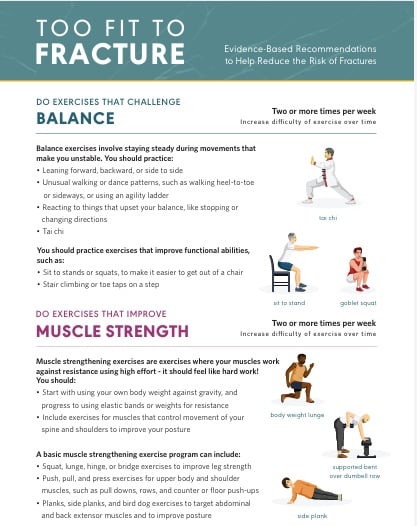
- Balance and functional training at least twice per week
- Doing balance work most days of the week is even better
Examples of balance training
- Sit‑to‑stand, squat, or lunge exercises
- Heel raises, or walking on heels or toes
- Activities that involve stepping, turning, or changing direction, like toe taps on a step, complex dance moves, or the ClockYourself app
- Reaching or weight‑shifting while standing, like Tai Chi, or staggered stance Romanian deadlifts
The key is that the exercise should feel challenging, but not so hard that you are worried you will fall.
Strength Training: Essential for Bone and Muscle Health
Strength (resistance) training is another cornerstone of the guidelines.
✅ What’s recommended
- Progressive resistance training at least twice per week
This helps you:
- Maintain muscle strength
- Support daily activities like stairs, lifting, and getting out of chairs
- Improve posture and spinal support
- Prepare your body safely for other activities
You don’t need complicated routines. A simple full‑body approach works well.
Key movement patterns to include
- Squats (for muscles in the legs and buttocks)
- Hinges (deadlift movement pattern - this sounds scary but it is really just bending more at the hips instead of the knees!)
- Push and pull exercises (arms and upper body - think pushups, chest press, shoulder press, lat pull down, cable pull downs or rows)
- Loaded carries (holding a weight in one or both hands while you stand tall, walk a distance, turn, and walk back)
- Exercises for abdominal and back extensor stabilizer muscles (like planks, side planks, bird-dogs)
Exercises should feel hard enough that you feel like could only do 1–2 more repetitions when you stop.
What About Bone Mineral Density?
What the evidence suggests:
- Resistance training combined with impact exercise may help maintain or modestly improve bone mineral density
- Walking, swimming, yoga, or Pilates alone have not been shown to increase bone mineral density in people with low bone mass
If your goal includes bone density:
- Start with balance and strength training
- Gradually layer in impact exercise, if appropriate for your fracture risk (check out our blog post on this topic! Click here to read it.
Impact should be introduced slowly and cautiously, and not everyone will be able to progress to high impact exercise.
Posture and Spine Health
Many people with osteoporosis are concerned about posture or a rounded upper back.
Exercise programs that focus on:
- Back extensor muscles
- Abdominal muscles
- Shoulder stabilizers
can:
- Improve posture slightly
- Improve function and confidence
Good posture isn’t about “standing up straight all the time”—it’s about having the strength and range of motion to be able to move with good alignment and do the activities you want to do.
Activities You Enjoy Still Count (With Some Caveats)
You don’t have to give up activities you love.
✔️ Enjoyment‑based activities (walking, dancing, pickleball, yoga, swimming) can:
- Improve mood
- Improve fitness
- Improve quality of life
But they should be done in addition to—not instead of—balance and strength training if fracture prevention is your goal.
Some movements may need to be modified, especially if you are at higher fracture risk.
Movements to Be Careful With
Avoiding all spine movement is not a good strategy. When loads on the spine are small, movement is healthy. The higher your fracture risk, the more likely you may need to avoid or modify certain movements.
Use caution with:
- Deep forward bending or twisting
- Combined bending and twisting
- High‑impact
- Fast, unpredictable activities, if balance is limited
Bending and twisting of the spine may increase fracture risk, especially if done:
- Rapidly
- Repetitively
- At end ranges of motion
- While holding weight
This does not mean “never bend.”
It means understanding your fracture risk and abilities, and working within them. Learn to:
- Keep your ribs stacked over your pelvis, or a neutral spine position
- Bend at the hips and knees
- Move slowly and with control
- Hold objects close to your body
Should You Work With an Exercise Professional To Design and Exercise Program?
If available, it’s strongly recommended—especially if you:
- Have had fractures
- Are at high fracture risk
- Feel unsure about how to exercise safely
Look for professionals (ideally a certified exercise physiologist or physical therapist that is BoneFit trained) familiar with osteoporosis who focus on:
- Strength and balance
- Evidence‑based practice
- Gradual, individualized progression
Frequently Asked Questions
Are some exercises “off limits” if I have osteoporosis?
There is no universal “yes or no.” Risk depends on:
- Your bone mineral density
- Your fracture history
- Your strength and balance
- Your experience level
Movements like heavy back squats, or high‑impact jumps may be appropriate for some people—but not as a starting point. Even some yoga movements might be risky for some people, and not for others. Exercise selection and careful progression matters.
Do I need to keep increasing the weight I lift?
Not necessarily. What matters is that the exercise feels challenging. You can increase difficulty by:
- Slowing down the movement
- Increasing range of motion
- Changing positions (e.g., one leg instead of two)
- Adding weight gradually, if appropriate
The Bottom Line
- ✅ Balance training is non‑negotiable
- ✅ Strength training is essential
- ✅ Enjoyable activities are encouraged—with modifications if needed
- ✅ Exercise risks exist, but serious injuries are rare
- ✅ Doing nothing because of fear is riskier than moving well
Exercise is not about being fearless—it’s about being informed, prepared, and confident.
If you’ve been diagnosed with osteoporosis, a challenging and progressive strength and balance training program is a solid investment of your time. Click here if you want a free booklet on exercise and osteoporosis.