Impact Exercise for Bone Health: Benefits, Risks, and Safe Progression
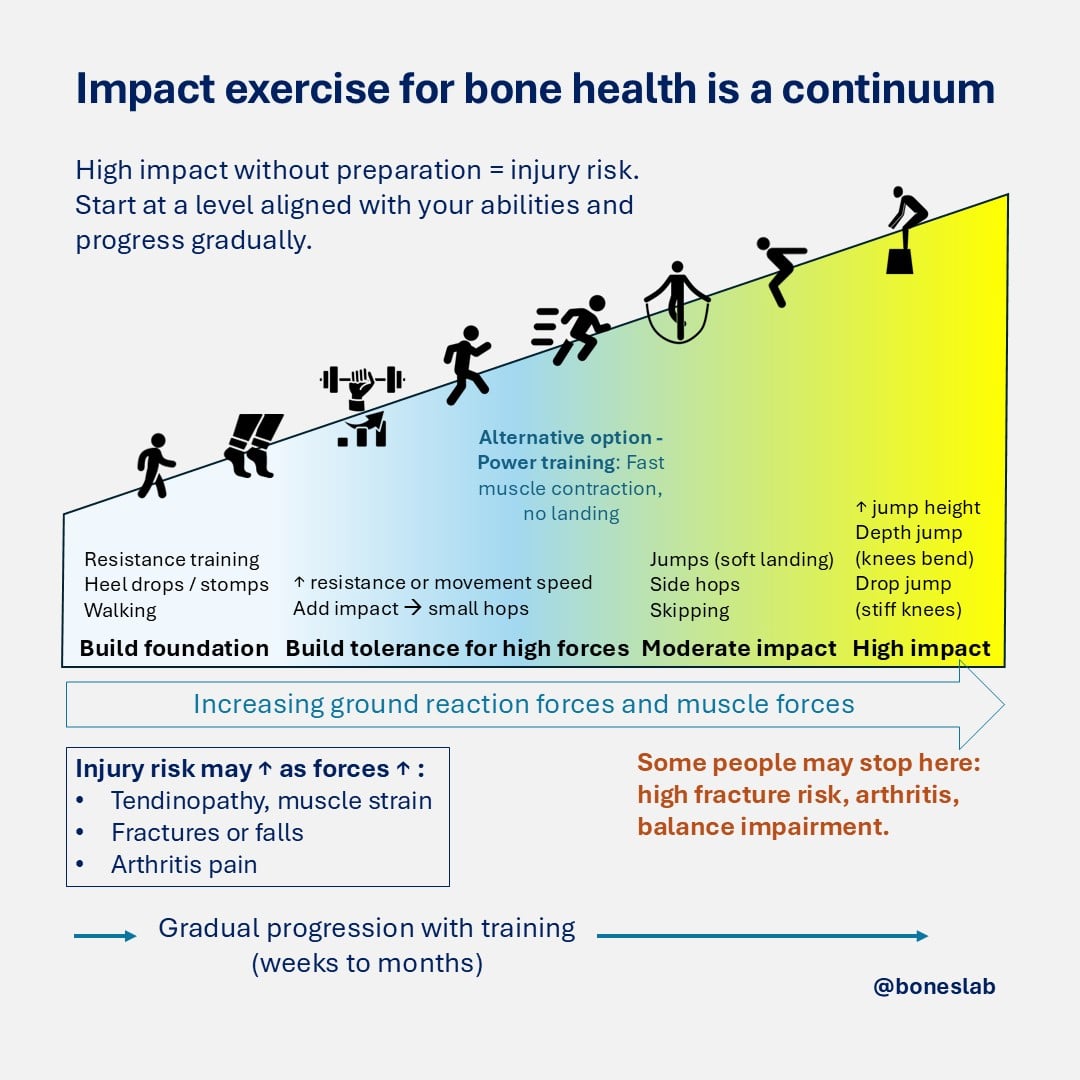
(Want to download the infographic? Click here!)
Impact exercise is often recommended to improve bone health and reduce fracture risk. You may have heard that jumping or running is the best way to strengthen your bones—but the answer isn’t that simple.
Impact exercise can help stimulate bone, but it is not appropriate for everyone. In some people, it may even increase the risk of falls, fractures, or injury. In this article, we explain what the science says about impact exercise for bone health, who may benefit, who should be cautious, and how to progress safely—if it’s right for you.
What Is Impact Exercise?
Impact exercise includes activities where your body experiences ground reaction forces—the force from the ground pushing back when your feet land.
Common examples include:
- Low impact: walking, marching, heel drops
- Moderate impact: jogging, skipping, small hops
- High impact: jump training, depth jumps, drop jumps
You may also hear the term weight‑bearing exercise, which refers to activities where you support your body weight through your legs (such as walking, stairs, or standing strength exercises). Not all weight‑bearing exercise is high impact.
Does Impact Exercise Improve Bone Health?
Both animal and human studies suggest that impact exercise can stimulate bone, particularly when movements are:
- Powerful, involving high ground reaction forces
- Different from everyday activities
This helps explain why athletes in sports that involve sprinting, jumping, and rapid direction changes often have higher bone mineral density than non‑athletes.
Animal studies also suggest that short, repeated bouts of impact are more effective for bone than long sessions performed less often. In practical terms, brief periods of impact may be more beneficial than long walks or runs a few times per week.
However, human research has limitations. Many studies:
- Combine impact exercise with strength training, making it difficult to isolate the effects of impact alone
- Are small or methodologically limited
- Focus on relatively healthy postmenopausal women, often excluding individuals with arthritis, spinal conditions, or higher fracture risk
Because of this, we cannot say that impact exercise alone is superior to strength training—or that everyone should perform high‑impact activities.
The strongest evidence supports combining strength training with appropriately chosen impact exercise, when it is safe to do so.
Impact Exercise Exists on a Continuum
Impact exercise for bone health is best thought of as a continuum, not an all‑or‑nothing recommendation.
The infographic above shows how impact and muscle forces increase gradually—from walking and resistance training, to moderate impact activities, and finally to high impact movements. As forces increase, the potential bone stimulus increases—but so does injury risk if progression happens too quickly or without preparation.
Some people may benefit from progressing along this continuum. Others may need to stay at lower‑impact levels due to fracture risk, joint pain, balance impairment, or other health conditions. There is no single “correct” level—only what is safest and most appropriate for the individual.
Is Impact Exercise Safe? Key Risks to Consider
There are three main risks associated with impact exercise:
1. Falls
Impact activities require good balance and coordination. Without adequate balance, fall risk increases.
2. Fractures
Higher impact means higher forces on bone. For people with very low bone mineral density, high‑impact exercise may increase fracture risk, particularly in the spine.
3. Injuries
Progressing too quickly can increase the risk of muscle, tendon, or joint injuries, such as Achilles tendinopathy or plantar fasciitis. Muscles and tendons also become less tolerant of sudden high loads with age.
The good news is that most of these risks can be reduced with proper preparation, exercise selection, and gradual progression.
How to Start Impact Exercise Safely: A 4‑Step Framework
There is no single “right” way to begin impact exercise. The framework below provides a practical, evidence‑informed approach.
Step 1: Build a Strong Foundation
Establish a regular routine that includes:
- Low‑impact aerobic exercise at least 3 times per week
- Challenging balance exercises most days
- Whole‑body strength training at least twice per week
Strength training should include weight‑bearing exercises such as squats, step‑ups, and controlled calf raises with heel drops.
Step 2: Increase Strength, Speed, and Agility
After weeks or months of consistent training:
- Perform leg exercises with slightly faster movement
- Increase resistance or step height
- Add multi‑directional movements, such as forward and side lunges
This stage improves your ability to absorb force safely before adding impact.
Step 3: Add Low‑Level Impact (If Appropriate)
If your fracture risk and fitness level allow, introduce small amounts of impact, such as:
- Small hops
- Side‑to‑side skater steps
- Stepping or lightly jumping down from a very low step with a soft landing
Impact should be added gradually and integrated into a structured program.
Step 4: Higher Impact (For Some People Only)
After building sufficient strength, balance, and tolerance, some individuals may progress to moderate or high impact activities like:
- Skipping
- Squat jumps
- Depth jumps
Many people will never need to reach this stage. Staying at Steps 1 or 2 is both common and appropriate for those at higher risk of falls or fractures.
Practical Tips for Impact Exercise
- Faster movements and higher jumps increase impact forces
- Hard surfaces (concrete) increase forces compared with softer surfaces
- Landing softly with bent knees reduces impact and injury risk
- Shoes with good traction can reduce fall risk
Working with an exercise physiologist can help tailor impact exercise to your health status and fracture risk.
Bottom Line: Impact Exercise and Bone Health
- Strength training is essential for bone health at all ages
- Impact exercise may help, but high impact is not appropriate for everyone
- The safest approach is to start low, build strength and balance, and progress gradually—only if appropriate for your fracture risk
If you read this and think, “I’m probably in Step 1 or 2,” that’s not a limitation - that is the smart choice for you. Start where you are at.
Click here to join our mailing list for more content like this!